A Pipeline Analysis of the New Female Directorial Voice
The Gendered Architecture of the Comedy Pipeline
Historically, Hollywood’s “sketch-to-feature” pipeline has functioned as a closed circuit of mobility for male creators while relegating female talent to a performer-labor model. While the industry saw Judd Apatow or Adam McKay transition seamlessly from writers’ rooms to directorial chairs, female icons like Julia Louis-Dreyfus or Cloris Leachman were often strategically pigeonholed into strictly acting roles, regardless of their generative comedic instincts. Today, however, we are witnessing a decisive pivot from this labor model toward an ownership-driven directorial model.
This institutional bypass is being fueled by a new generation of creators who leverage the intellectual rigor of university incubators—specifically Northwestern University—to secure aesthetic sovereignty. Northwestern has evolved from the traditional “revue format” of the Waa-Mu Show into a sophisticated incubator for new content, formalized through its “Comedy Arts Module” and “Sitcom Sequence.” This pipeline is producing a “smart take” cohort—alumni like Ashley Nicole Black, Nicole Silverberg, and the duo Jocelyn DeBoer and Dawn Luebbe—who prioritize the work habits and pattern recognition learned in Evanston over traditional gatekeeper approval. For these creators, the journey from the Upright Citizens Brigade (UCB) stage to the directorial monitor is a calculated maneuver to maintain total creative control, forging a unique creative methodology born in the improv crucible.
The “Yes, And” Framework: Improvisation as a World-Building Logic
The “Yes, And” cognitive framework, often dismissed as a mere performance tool, is being repurposed by contemporary directors as a foundational logic for narrative surrealism. This is not about spontaneous jokes; it is about building an asymmetric narrative architecture where absurd premises are accepted as the baseline reality. The UCB-forged partnership of Jocelyn DeBoer and Dawn Luebbe (Gulp Splash Productions) exemplifies this shift. By applying improv principles to filmic structure, they have moved beyond the “actor showcase” model of their early UCB “Onassis” sketches to create totalizing directorial projects that bend logic with deadpan sincerity.
This methodology creates a “domestic grotesque” that finds its historical lineage in the work of Luis Buñuel, particularly The Discreet Charm of the Bourgeoisie, where social expectations are established only to be systematically dismantled by surreal disruptions. Like the “dollhouse” melodramas of Douglas Sirk or the psychotic suburban landscapes of David Lynch, DeBoer and Luebbe treat events like a mother giving birth to a soccer ball or a child transforming into a golden retriever with the mundane gravity of a PTA meeting. This escalation of the absurd allows for a scathing critique of suburban performativity, but transitioning such a vision from short-form sketch to a feature-length blueprint requires an arduous journey through the indie threshold.
The Indie Threshold: Navigating the Transition to Feature Directing
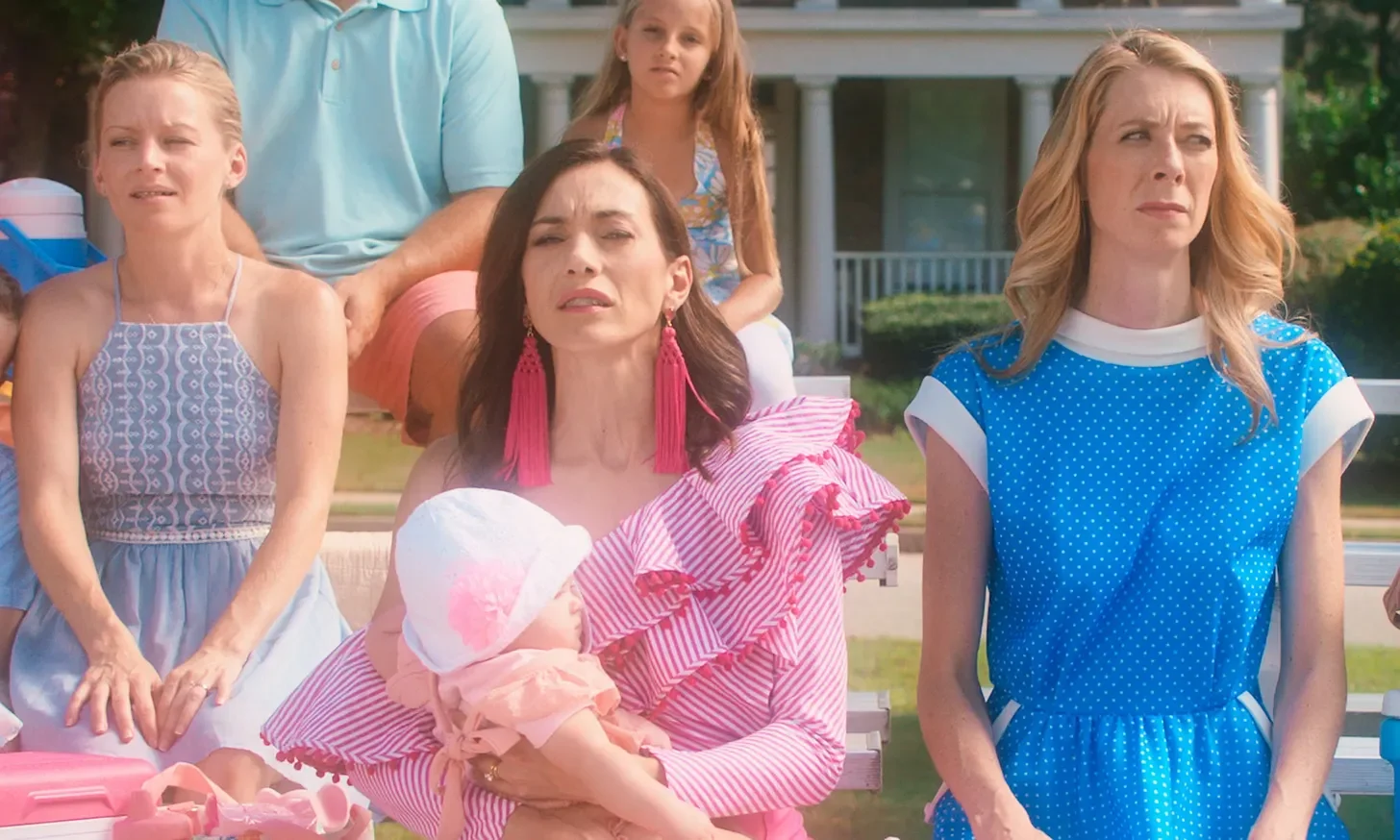
In the modern market, the “indie hustle” is a strategic necessity. Independent production provides the “space to be weird” required for market differentiation when traditional studio budgets remain risk-averse. The development history of Greener Grass serves as a definitive case study in this career persistence. Originally a 2015 short, the project was initially developed as an IFC television pilot supported by a massive “TV Bible” outlining six seasons of narrative arcs. When the pilot stalled due to the high budgetary demands of its expansive world-building, the duo pivoted to a feature model, executing a pivot sparked specifically by DeBoer’s experience on the set of Jim Cummings’ Thunder Road.
Between January and May 2018, DeBoer and Luebbe produced 22 drafts of the screenplay, refining it into a meticulous production blueprint. Under the guidance of producer Natalie Metzger (Vanishing Angle), the production was accelerated to meet Sundance deadlines. To protect their artistic vision on a limited budget, the directors established rigid “directorial rules” to maintain aesthetic control. By filming in Peachtree City, Georgia—the “golf cart capital of the world”—they utilized the city’s 100 miles of paved paths to enforce a “no cars” policy. They further mandated a total ban on the colors red and black, forcing the visual eye toward hyper-saturated pastels and creating a toy-like, artificial environment that serves as the backdrop for their suburban grotesque.
The Suburban Grotesque: Aesthetic Sovereignty in the Streaming Era
In a saturated streaming landscape, a singular visual style is more than an artistic choice; it is a vital branding asset for cut-through. DeBoer, Luebbe, and cinematographer Lowell A. Meyer achieved this through a technical execution they define as the “Horror of Brightness.” By utilizing high-key, shadowless, and over-exposed lighting, they subverted traditional horror tropes, finding dread in over-manicured perfection. This aesthetic sovereignty was maintained through low-budget technical innovations, such as mounting a bicycle helmet on a C-Stand to stabilize DeBoer’s head for a grueling three-minute opening shot involving dental braces and quivering discomfort.
The “color ban” on red and black was a strategic move to create a “day-glo” aesthetic that masks psychological horror behind a facade of “all-too-bright” normalcy. This serves the film’s “So What?” layer: a critique of the identity crisis inherent in the social media age. Symbols such as universal dental braces, pool-water addiction, and artificial foliage (silk flowers placed in natural bushes by production designer Leigh Poindexter) satirize the performative conformity of the middle class. The ultimate validation of this assured visual tone came with the duo’s signing by Biscuit Filmworks. This commercial pivot point proves that surrealism is no longer a fringe aesthetic but a viable visual brand for high-stakes commercial representation, marking a successful evolution of the low-budget female voice into the mainstream market.
Evaluating the Future of the Surrealist Pipeline
The “Northwestern/UCB to Indie Feature” pipeline has fundamentally altered career expectations for the next generation of comedic minds. By synthesizing the intellectual rigor of Evanston with the adaptive logic of the improv stage, creators are no longer waiting for a seat at the table—they are building the table from scratch. The success of this surrealist pipeline demonstrates that complete creative control is a professional requirement for maintaining an uncompromised vision in a competitive, non-specialist landscape.
As the industry shifts, the strategic takeaway for emerging directors is clear: the path to longevity lies in the transition from performer-labor to creative ownership. The evolution of the suburban grotesque and the rise of hyper-stylized satire prove that the most potent directorial voices are those that own the tools of their own world-building. In the new comedic economy, the grass is only greener for those with the strategic foresight to design, plant, and protect their own surrealist landscape.
Works cited
“35th Independent Spirit Awards.” Wikipedia, 27 Oct. 2025, https://en.wikipedia.org/wiki/35th_Independent_Spirit_Awards.
Berkeley, Leo. “Between Chaos and Control: Improvisation in the Screen Production Process.” TEXT Special Issue, ASPERA: New Screens, New Producers, New Learning, Apr. 2011, pp. 1-13.
“Biscuit Filmworks Signs Directing Duo Jocelyn & Dawn.” Shots.net, 8 Dec. 2020, https://shots.net/news/view/biscuit-filmworks-signs-directing-duo-jocelyn-and-dawn.
“Dawn Luebbe.” Earwolf, 20 Oct. 2019, https://www.earwolf.com/person/dawn-luebbe/.
Dean, Sadie. “Sundance Film Festival 2023 – Trust the Process: A Conversation with 2022 Women Write Now Fellowship Writers & Guest Directors.” Script Magazine, 27 Jan. 2023, https://scriptmag.com/interviews-features/sundance-film-festival-2023-trust-the-process-a-conversation-with-2022-women-write-now-fellowship-writers-guest-directors.
“Directing Duo Jocelyn & Dawn Joins Biscuit Filmworks For 1st Career Spot Representation.” SHOOTonline, 7 Dec. 2020, https://www.shootonline.com/article/directing-duo-jocelyn-dawn-joins-biscuit-filmworks-1st-career-spot-representation/.
“Filming in the Golf Cart Capital of the World: Jocelyn DeBoer and Dawn Luebbe on Greener Grass.” Georgia Entertainment, 24 Oct. 2019, https://www.georgiaentertainment.com/2019/10/filming-in-the-golf-cart-capital-of-the-world-jocelyn-deboer-and-dawn-luebbe-on-greener-grass/.
“Greener Grass.” IFC Center, 2021, https://www.ifccenter.com/films/greener-grass/.
“Greener Grass.” Palm Springs International Film Festival, 17 June 2026, https://www.psfilmfest.org/events/ucr-public-forum/greener-grass.
“Greener Grass.” Wikipedia, 18 Feb. 2026, https://en.wikipedia.org/wiki/Greener_Grass.
“Independent Spirit Award for Best First Screenplay.” Wikipedia, 20 Feb. 2026, https://en.wikipedia.org/wiki/Independent_Spirit_Award_for_Best_First_Screenplay.
Itkonen, Joonatan. “Jocelyn DeBoer & Dawn Luebbe Talk About the Suburbs, Comedy, and Rewriting.” RegionFree, 25 Sept. 2020, https://regionfree.net/hiff-jocelyn-deboer-dawn-luebbe/.
“Jocelyn DeBoer.” Upright Citizens Brigade, https://ucbcomedy.com/people/jocelyn-deboer/.
“Jocelyn DeBoer & Dawn Luebbe On Their Sundance Breakout ‘Greener Grass’ And UCB Loyalties [Interview].” The Playlist, 18 Oct. 2019, https://theplaylist.net/jocelyn-deboer-dawn-luebbe-greener-grass-interview-20191018/.
Jones, Rendy. “’Greener Grass’ Review: Ambitious and Funny Breakthrough Debut of Comedic Duo DeBoer and Luebbe.” Rendy Reviews, 11 Oct. 2019, https://www.rendyreviews.com/movie-reviews/greener-grass-review.
---. “Jocelyn DeBoer and Dawn Luebbe on Greener Grass.” We Live Entertainment, 23 Oct. 2019, https://weliveentertainment.com/welivefilm/jocelyn-deboer-and-dawn-luebbe-on-greener-grass/.
Keane, Meagan. “Josephine Decker Turns the Filmmaking Process on Its Head.” Adobe Blog, 12 Feb. 2018, https://blog.adobe.com/en/publish/2018/02/12/josephine-decker-turns-filmmaking-process-head.
Klotz-Guest, Kathy. “Women, Careers and Risk: Lessons from the Improv Comedy Stage.” Scrappy Women in Business, 12 Nov. 2013, https://scrappywomen.biz/women-careers-and-risk-lessons-from-the-improv-comedy-stage-by-kathy-klotz-guest/.
Luers, Erik. “Filming in the Golf Cart Capital of the World: Jocelyn DeBoer and Dawn Luebbe on Greener Grass.” Filmmaker Magazine, 23 Oct. 2019, https://filmmakermagazine.com/108465-jocelyn-deboer-dawn-luebbe-greener-grass/.
McCarthy, Sean L. “Jocelyn DeBoer and Dawn Luebbe.” The Comic’s Comic Presents Last Things First, 22 Oct. 2019, https://thecomicscomic.libsyn.com/jocelyn-deboeranddawn-luebbe.
“Narrative Surrealism and the Suburban Grotesque: A Directorial Study of Jocelyn DeBoer and Dawn Luebbe’s Greener Grass (2019).” Directorial Study Report, Nov. 2019.
Oakes, Matt. “Beyond the Pale of ‘GREENER GRASS’: An Exclusive Interview with Comedy Bombshells Jocelyn DeBoer and Dawn Luebbe.” Silver Screen Riot, 25 Oct. 2019, https://silverscreenriot.com/beyond-the-pale-of-greener-grass-an-exclusive-interview-with-comedy-bombshells-jocelyn-deboer-and-dawn-luebbe/.
O’Malley, Sheila. “Greener Grass Movie Review & Film Summary.” Roger Ebert, 18 Oct. 2019, https://www.rogerebert.com/reviews/greener-grass-movie-review-2019.
“On The Rise 2015: 20 Directors To Watch.” The Playlist, 2015, https://theplaylist.net/.
Saito, Stephen. “Interview: Jocelyn DeBoer and Dawn Luebbe on Cultivating ‘Greener Grass’.” The Moveable Fest, 18 Oct. 2019, https://moveablefest.com/jocelyn-deboer-dawn-luebbe-greener-grass-interview/.
Schoenbrun, Jane. “Five Questions with Appropriate Behavior Director Desiree Akhavan.” Filmmaker Magazine, 18 Jan. 2014, https://filmmakermagazine.com/83907-five-questions-with-appropriate-behavior-director-desiree-akhavan/.
“The Rise of Female Surrealism in Independent Comedy.” Directorial Pipeline Analysis Report, 2026.
Thompson, Valerie. “Greener Grass’ Jocelyn DeBoer, Dawn Luebbe and Natalie Metzger Reveal the Behind-the-Scenes Secrets of Their Sundance Hit.” Film Obsessive, 2019, https://filmobsessive.com/film/film-analysis/comedy-films/greener-grass-jocelyn-deboer-dawn-luebbe-and-natalie-metzger-reveal-the-behind-the-scenes-secrets-of-their-sundance-hit/.
Trotter, Kerry, and Cara Lockwood. “Summer 2019.” Dialogue, Northwestern University School of Communication, July 2019, pp. 1-68.
“UCLA Electronic Theses and Dissertations.” eScholarship.org, University of California, https://escholarship.org/uc/ucla_etd.
Wade, Joseph. “Greta Gerwig: The Essential Collection.” The Film Magazine, 14 July 2023, https://www.thefilmagazine.com/greta-gerwig-essential-collection/.
